We’re extraordinarily committed to systems change. We’re never doing something just to do it once — we’re doing it so it becomes the way the whole system then works.
Sarah Chandler, Apple’s vice president of Environment and Supply Chain Innovation
Mapping the future with 3D‑printed titanium Apple Watch cases
It started with a pie-in-the-sky idea: What if 3D printing — historically used to create prototypes — could be leveraged to produce millions of identical enclosures to Apple’s exact design standards, with high-quality recycled metal?
“It wasn’t just an idea — it was an idea that wanted to become a reality,” says Kate Bergeron, Apple’s vice president of Product Design. “Once we asked the question, we immediately started testing it. We had to prove, with continuous prototyping, process optimization, and a tremendous amount of data gathering, that this technology was capable of meeting the high standard of quality we demand.”
This year, all Apple Watch Ultra 3 and titanium Apple Watch Series 11 cases are 3D-printed with 100 percent recycled aerospace-grade titanium powder, an achievement not previously considered possible at scale. Every team at Apple rallied behind a shared ambition. The polished mirror finish on Series 11 had to be pristine. Ultra 3 had to maintain its durability and lightweight form to meet the demands of everyday adventurers. They both also had to be better for the planet without compromising performance, and use the same or better-quality materials.
“At Apple, every team holds environment as a core value,” says Sarah Chandler, Apple’s vice president of Environment and Supply Chain Innovation. “We knew 3D-printing was a technology with so much potential for material efficiency, which is critical for getting to Apple 2030.”
Apple 2030 is the company’s ambitious goal to be carbon neutral across its entire footprint by the end of this decade, which includes the manufacturing supply chain and lifetime use of its products. Already, all of the electricity used to manufacture Apple Watch comes from renewable energy sources like wind and solar.
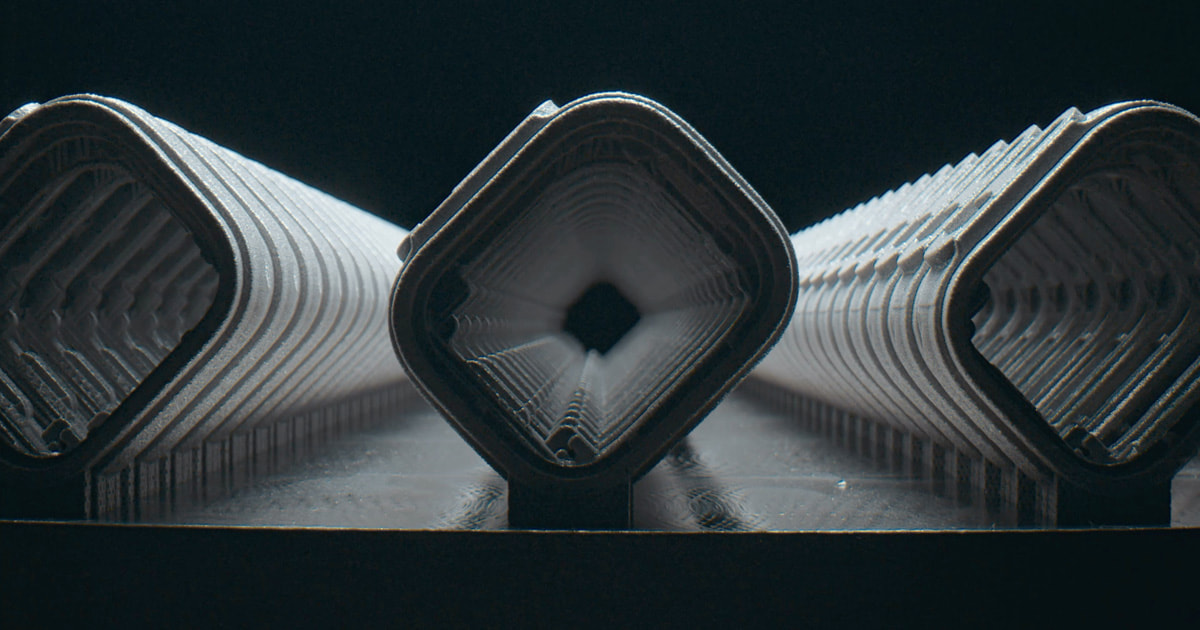
Using the additive process of 3D printing, layer after layer gets printed until an object is as close to the final shape needed as possible. Historically, machining forged parts is subtractive, requiring large portions of material to be shaved off. This shift enables Ultra 3 and titanium cases of Series 11 to use just half the raw material compared to their previous generations.
“A 50 percent drop is a massive achievement — you’re getting two watches out of the same amount of material used for one,” Chandler explains. “When you start mapping that back, the savings to the planet are tremendous.”
In total, Apple estimates more than 400 metric tons of raw titanium will be saved this year alone thanks to this new process.
Over the past decade, Apple has been experimenting with 3D printing while the industry itself was starting to take off. In hospital labs, doctors were using the first 3D-printed prosthetics and artificial organs, and even beyond Earth’s atmosphere, astronauts discovered the speed and ease of 3D-printing vital tools while aboard the International Space Station.
“We’ve watched this technology mature for a long time and seen its prototypes become more representative of our designs,” says Dr. J Manjunathaiah, Apple’s senior director of Manufacturing Design for Apple Watch and Vision. “Using less material to make our products has always been the intention. Previously, we hadn’t been able to make cosmetic parts at scale with 3D printing. So we started to experiment with 3D-printing metal to make cosmetic parts.”
For Apple, functionality, beauty, and durability are table stakes. Add on scalability, along with rigorous reliability testing, performance, and even breakthroughs in materials science, all while ensuring Apple doesn’t lose any ground in its 2030 decarbonization goals.