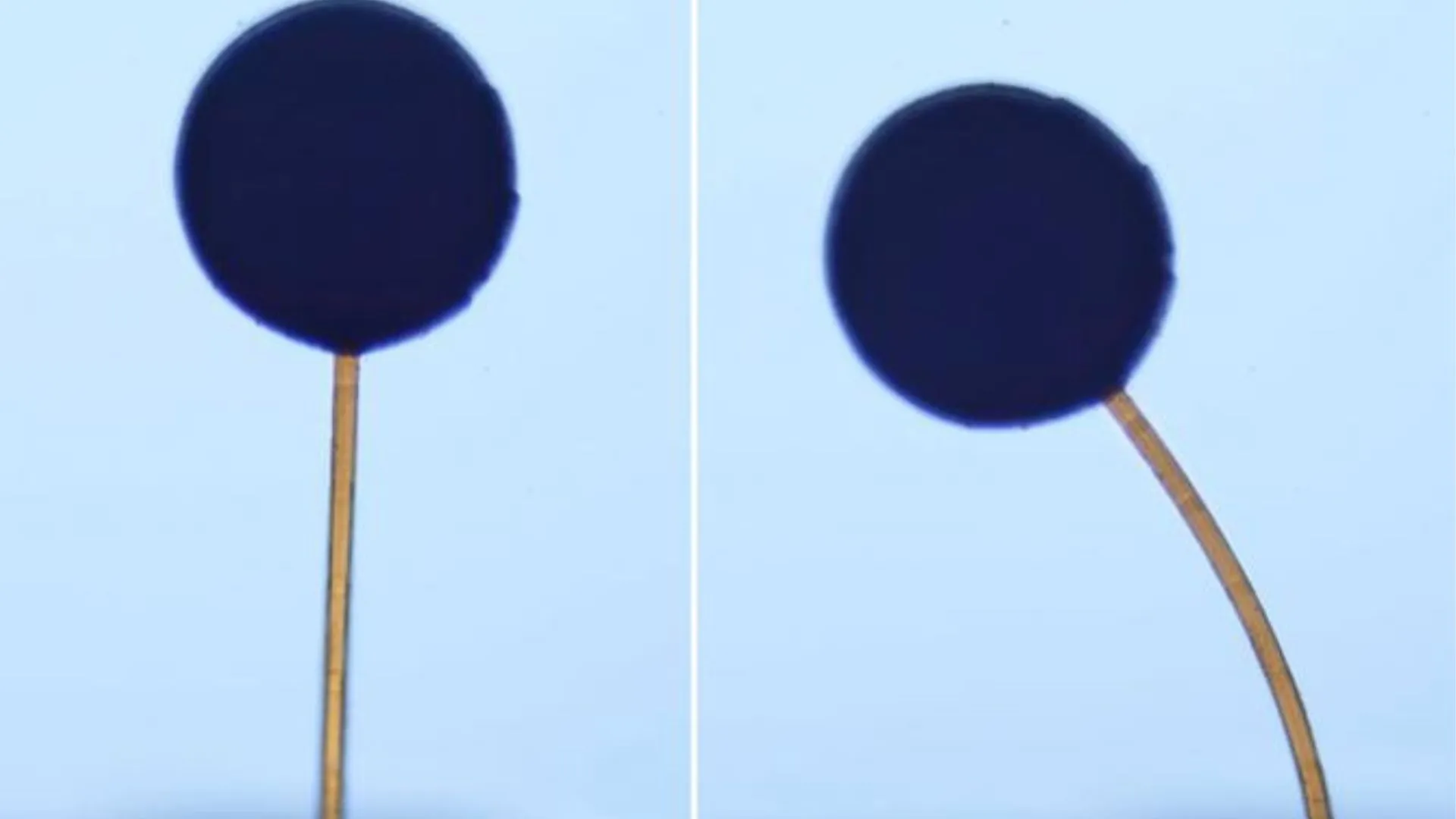
This technology could lead to microscopic robots capable of performing delicate medical tasks inside the human body, such as retrieving biopsies or delivering medication.
Engineers have developed a new soft magnetic hydrogel that can be 3D-printed into microscopic structures.
Compared with previous magnetic materials that move as a single unit, this new gel allows individual parts of a tiny robot to deform and move independently in response to an external magnet.
The development comes from the Massachusetts Institute of Technology (MIT), the Swiss Federal Institute of Technology of Lausanne (EPFL), and the University of Cincinnati.
These magnetically controlled soft robots, or magno-bots, could be used in healthcare to collect tiny medical samples or deliver medicine into the body.
“We can now make a soft, intricate 3D architecture with components that can move and deform in complex ways within the same microscopic structure. For soft microscopic robotics, or stimuli-responsive matter, that could be a game-changing capability,” said Carlos Portela, study author from MIT.
MIT researchers are prioritizing magnetic stimuli over other triggers — like light or chemicals — because of their unique speed and convenience.
Magnetic fields can help achieve instantaneous, wireless control from a distance, bypassing the need for slow chemical reactions or physical contact. This “programmable” approach enables immediate manipulation of a material’s properties for high-precision, remote-controlled micro-robotics.
The new work has created tiny 3D-printed “lollipops” made of a special magnetic gel, each smaller than a grain of sand. Interestingly, it can instantly transform into robotic grippers when a magnet is waved near it.
To create magnetically responsive structures smaller than a millimeter, researchers typically rely on two-photon lithography, a high-resolution 3D printing technique that uses lasers to solidify resin.
However, standard 3D printing of magnetic materials is difficult because magnetic nanoparticles — essentially tiny bits of metal — scatter the laser light and clump together. This interference reduces the laser’s power and compromises the structural integrity of the print, often rendering it impossible to produce intricate, functional microdesigns.
“Directly 3D printing deformable micron-scale structures with a high fraction of magnetic particles is extremely difficult, often involving a tradeoff between magnetic functionality and structural integrity,” said Rachel Sun, co-lead author.
To overcome these printing obstacles, a “double-dip” fabrication process was used in this work. It adds magnetic properties after the 3D printing is complete.
The team first prints a clean polymer microstructure and then submerges it in successive chemical baths to grow iron-oxide nanoparticles directly within the gel.