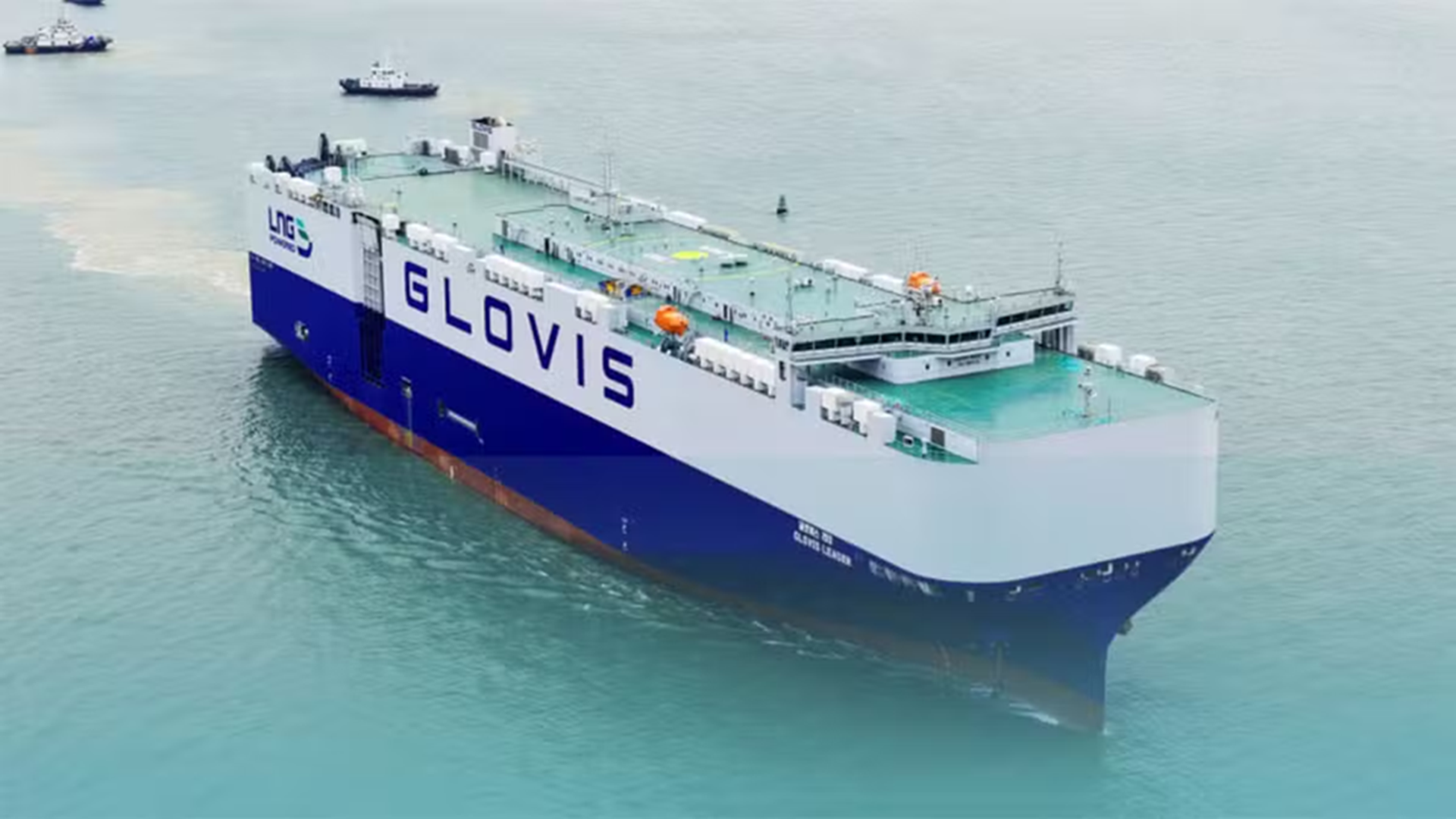
The ship’s decks are designed to handle EVs, hydrogen cars and heavy-duty trucks.
China has just delivered the world’s largest car carrier, a colossal vessel capable of transporting up to 10,800 vehicles in a single voyage, which is enough to stretch roughly 31 miles (50 kilometers) if lined up bumper to bumper.
The massive vessel was developed by Guangzhou Shipyard International (GSI), a Chinese state-owned shipbuilding enterprise under the China State Shipbuilding Corporation (CSSC). It was handed over to South Korea’s HMM, in the southern Chinese city of Guangzhou on Tuesday, April 28. It will be operated by Hyundai Glovis.
Named Glovis Leader, the ship stands at 754 feet (230 meters) long and 131 feet (40 meters) wide. It is reportedly made to function as a high-efficiency “floating parking structure,” and underscores the nation’s expanding dominance in both shipbuilding and electric vehicle (EV) exports.
“This vessel is a green energy ship equipped with an LNG (liquefied natural gas) system,” Zhang Fuli, technical manager at GSI, reported. “It also features a shaft generator system, which can power the entire ship independently while at sea, a key aspect of its energy efficiency.”
The Glovis Leader boasts 14 decks, which can accommodate a wide range of cars, whether conventional passenger cars, electric vehicles (EVs), hydrogen-powered models, or heavy-duty trucks. It is powered by an advanced dual-fuel propulsion system which runs on liquefied natural gas (LNG) and conventional marine fuel.
“We have also completed preliminary feasibility studies on ammonia and methanol fuel retrofits, allowing the vessel to be modified to run on these alternative fuels if the shipowner requires,” Fuli continued.
Because of this setup, the vessel meets the stringent Tier III emissions standards of the International Maritime Organization (IMO). It significantly reduces nitrogen oxide emissions compared to traditional ships.
According to CnEVPost, the ship boasts a maximum speed of 19 knots and a draft of 34.4 feet (10.5 meters). It can efficiently handle long-distance travel, in addition to international routes.
Lee Kyoo-bok, Hyundai Glovis CEO, emphasized that the vessel is more than an ordinary transport ship. “With its large capacity and enhanced green operating system, it is expected to set a new benchmark for global seaborne automobile transport and mark an important milestone for the shipping industry,” he added.
As per industry experts, the new delivery highlights China’s advancing high-end shipbuilding capabilities. It moreover signals a wider shift in the global shipping sector toward lower-carbon operation.
Chinese shipyards have repeatedly set records for the world’s largest car carriers in recent years. In late April 2025, the BYD Shenzhen, a ship with a 9,200-vehicle capacity, began its first export voyage. BYD owns two more vessels with the same capacity, the BYD Changsha and the BYD Xi’an.
Meanwhile, less than a month later, the Anji Ansheng, capable of carrying 9,500 vehicles, departed Shanghai for Europe on its maiden journey. Both ships were designed and built domestically by Chinese yards.
GSI has secured over 40 car carrier orders and has delivered 26 so far. Every vessel has been completed ahead of schedule, sources disclosed. This includes 11 ships in 2025, delivered an average of 151 days early. The company currently has orders worth about CNY 100 billion (USD 14.6 billion).